

Quick answer: Postbiotic supplements contain deliberately inactivated microorganisms, their components, or both. Early research suggests that certain postbiotic preparations may support digestive function, the intestinal barrier, immune regulation, and metabolic health. However, the benefits are product-specific, and the evidence is not yet strong enough to recommend postbiotics as a universal solution for gut problems.
Probiotics and prebiotics have dominated the gut-health conversation for years. Now, a third term is appearing on supplement labels and wellness websites: postbiotics.
The growing interest makes sense. Unlike probiotics, postbiotics do not rely on living microorganisms surviving manufacturing, storage, and passage through the digestive tract. This could make some preparations more stable and predictable.
But postbiotics are also surrounded by confusing definitions and aggressive marketing. Some products use the term for almost any compound made by bacteria, even though that does not match the scientific consensus definition.
Here is what consumers should understand about postbiotic supplements, their potential benefits, their limitations, and how to evaluate a product without falling for exaggerated claims.
What Are Postbiotics?
The International Scientific Association for Probiotics and Prebiotics, or ISAPP, defines a postbiotic as:
A preparation of inanimate microorganisms and/or their components that confers a health benefit on the host.
In simpler terms, a postbiotic starts with microorganisms that have been deliberately inactivated. The final preparation may contain whole inactivated microbial cells, fragments of those cells, structural components, or substances created during processing.
The word inanimate is important. It means the microorganisms are no longer alive, but it does not necessarily mean they are biologically inactive. Components of the microorganisms may still interact with the intestinal lining, immune cells, or other parts of the body.
A preparation should also demonstrate a measurable health benefit before it is properly called a postbiotic. Simply heat-killing bacteria and putting them into a capsule does not automatically make the product clinically effective.
Postbiotics vs. Probiotics vs. Prebiotics
Understanding the difference between these three terms can make gut-health products much easier to evaluate.
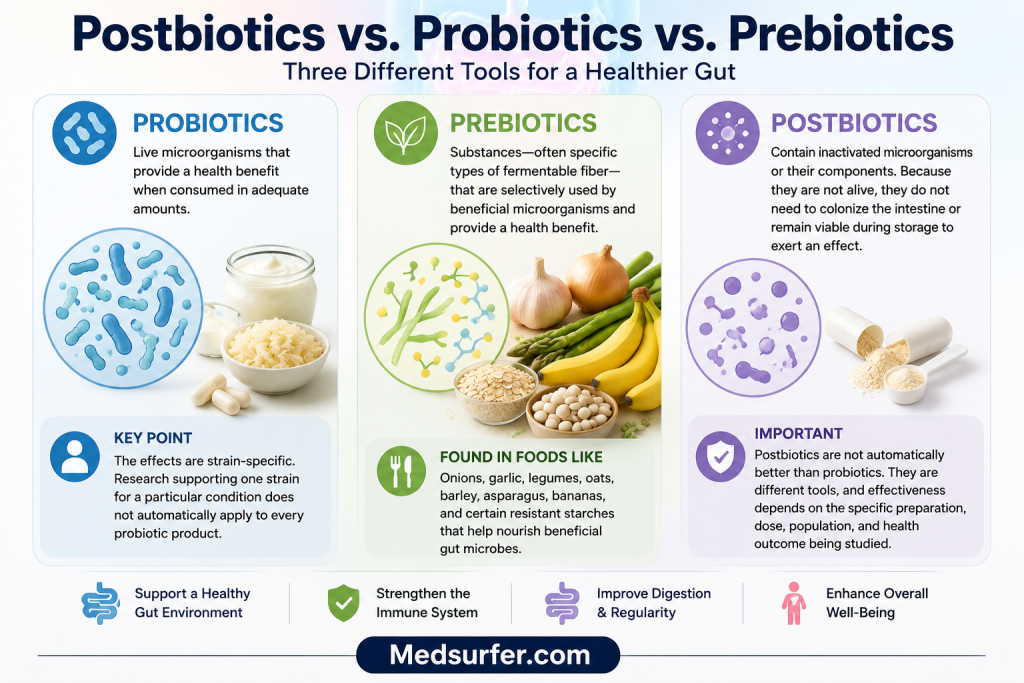
Probiotics
Probiotics are live microorganisms that provide a health benefit when consumed in adequate amounts. Certain strains of Lactobacillus, Bifidobacterium, and other organisms are commonly used in probiotic foods and supplements.
The effects of probiotics are strain-specific. Research supporting one strain for a particular condition does not automatically apply to every probiotic product.
Learn more in MedSurfer’s guide to prebiotics, probiotics, and fermented foods.
Prebiotics
Prebiotics are substances—often specific types of fermentable fiber—that are selectively used by beneficial microorganisms and provide a health benefit.
Foods containing onions, garlic, legumes, oats, barley, asparagus, bananas, and certain resistant starches may help nourish beneficial gut microbes.
For practical ways to increase fiber variety, read Fiber Diversity for Gut Health.
Postbiotics
Postbiotics contain inactivated microorganisms or their components. Because they are not alive, they do not need to colonize the intestine or remain viable during storage to exert an effect.
That does not mean postbiotics are automatically better than probiotics. They are different tools, and the effectiveness of either depends on the specific preparation, dose, population, and health outcome being studied.
How Might Postbiotics Work?
Postbiotic preparations may contain several biologically active components, depending on how they are produced.
These may include:
- Inactivated microbial cells
- Cell-wall fragments
- Proteins and peptides
- Enzymes
- Organic acids
- Polysaccharides
- Other compounds retained in the final preparation
Researchers are studying several possible mechanisms.
Interaction with the intestinal barrier
The intestinal barrier helps regulate what passes from the digestive tract into the bloodstream. Certain microbial components may interact with intestinal cells and influence tight-junction proteins, mucus production, and other barrier functions.
Much of this research is still preclinical, meaning it comes from laboratory or animal models. Human evidence is developing but remains dependent on the specific preparation.
Immune-system signaling
Components of inactivated microorganisms may be recognized by receptors on intestinal and immune cells. This interaction could influence inflammatory signaling or immune responses.
The effect is not simply “boosting immunity.” The immune system requires balance, not constant stimulation. Depending on the preparation and context, postbiotics may influence immune regulation rather than merely making the immune system more active.
Effects on the gut environment
Some preparations may change intestinal conditions in ways that support beneficial organisms or discourage potentially harmful microbes.
However, a postbiotic does not necessarily “repopulate” the microbiome because it does not contain live organisms. Claims that it permanently restores or resets the microbiome should be treated cautiously.
Potential Postbiotic Supplements Benefits
Postbiotic research is expanding, but the quality and quantity of evidence vary considerably. Most benefits should be considered potential and formulation-specific, not established effects of every postbiotic supplement.
1. Support for digestive function
Some clinical studies have examined inactivated microbial preparations for diarrhea and other digestive symptoms.
For example, a 2024 clinical study of young adults with chronic diarrhea reported improvements in stool consistency, bowel frequency, urgency, and some microbiome measures after a specific postbiotic intervention.
That does not prove that all postbiotics treat diarrhea. Different products may use different organisms, inactivation methods, doses, and combinations of microbial components.
Persistent diarrhea should be medically evaluated, particularly when accompanied by dehydration, fever, blood in the stool, nighttime symptoms, or unintended weight loss.
2. Possible intestinal-barrier support
Laboratory studies suggest that certain postbiotic components may support intestinal cells and influence the proteins involved in barrier integrity.
This is one reason postbiotics are being investigated for conditions associated with intestinal inflammation or impaired barrier function.
Consumers should be cautious with broad “leaky gut cure” claims. Intestinal permeability is a complex biological process, and persistent digestive symptoms may have causes requiring medical diagnosis.
A high-fiber dietary pattern, adequate nutrition, sleep, physical activity, and appropriate treatment of underlying disease remain more established foundations for digestive health.
3. Immune regulation
The digestive tract contains a large and active immune network. Microbial components can interact with this system, making immune regulation one of the most promising areas of postbiotic research.
Studies have investigated postbiotics in respiratory infections, childhood illness, inflammatory conditions, and allergic disease. Results are mixed, and positive findings generally apply to a particular preparation rather than to the entire category.
Postbiotics should not be marketed as replacements for vaccines, infection treatment, allergy care, or other established medical therapies.
4. Potential metabolic-health effects
Researchers are examining whether postbiotics may influence blood sugar regulation, insulin sensitivity, blood lipids, appetite signaling, inflammation, and body composition.
A 2025 systematic review and meta-analysis reported modest improvements in selected metabolic outcomes, including insulin sensitivity, triglycerides, central adiposity, and inflammatory markers. However, the included studies used different products and populations, and additional standardized trials are needed.
Postbiotic supplements should not replace nutrition, exercise, sleep, weight-management care, or prescribed medications for diabetes, high cholesterol, or cardiovascular risk.
5. Stability compared with live probiotics
A practical advantage of postbiotics is that they do not need to remain alive.
Live probiotic products may be affected by:
- Temperature
- Humidity
- Storage time
- Manufacturing conditions
- Exposure to stomach acid
- Interactions with other ingredients
Postbiotic preparations may have a longer shelf life and less sensitivity to environmental conditions. This could make dosing and manufacturing more consistent.
Stability, however, is not the same as clinical effectiveness. A stable product is valuable only when the final preparation has evidence supporting its intended use.
Are Postbiotics Better Than Probiotics?
Postbiotics are not universally better or worse than probiotics.
A probiotic may be appropriate when a specific live strain has evidence for a particular purpose. A postbiotic may be preferred when stability is important or when a researched inactivated preparation has demonstrated benefits.
Postbiotics may theoretically reduce some risks associated with administering live microorganisms. Rare but serious infections related to probiotic organisms have occurred, particularly in premature infants and severely ill or immunocompromised patients.
Because postbiotics do not contain viable organisms, they may offer a safety advantage in some situations. Nevertheless, people with significant illness or weakened immunity should not assume that every postbiotic is safe. Product contaminants, other ingredients, allergic reactions, and interactions remain possible.
Read MedSurfer’s overview of balancing the gut microbiome with prebiotics and probiotics for a broader comparison.
Can You Get Postbiotics From Food?
Your intestinal microbes naturally create many biologically active substances when they ferment dietary fiber. Short-chain fatty acids such as butyrate, acetate, and propionate are among the best-known microbial fermentation products.
However, purified short-chain fatty acids or isolated bacterial metabolites are not necessarily postbiotics under the formal ISAPP definition. A postbiotic preparation must include inactivated microbial cells, their components, or both.
Rather than trying to eat a specific “postbiotic food,” a practical approach is to support your own microbiome with:
- A diverse range of fiber-rich plants
- Beans and lentils
- Whole grains
- Nuts and seeds
- Fruits and vegetables
- Fermented foods when tolerated
- Adequate sleep
- Regular physical activity
- Stress-management practices
These habits support the gut ecosystem and the production of beneficial microbial compounds.
For a wider look at the digestive system’s relationship with whole-body health, see What Is the Gut-Brain Axis and Why Does It Matter?.
What to Look for in a Postbiotic Supplement
The term “postbiotic” on the front of a label is not enough. Before buying a product, look for the following information.
The specific microorganism
A credible label should identify the microorganism used to create the preparation. Ideally, it should list the genus, species, and strain.
Evidence for one strain or preparation cannot automatically be transferred to another.
The inactivation method
Manufacturers may use heat, pressure, irradiation, sonication, or another method to inactivate microorganisms. The technique can change the final product’s structure and biological activity.
A product tested in clinical research should be manufactured in a way that closely matches the researched preparation.
A defined dose
Live probiotics are frequently measured in colony-forming units. That measurement does not work for inactivated organisms because they cannot form colonies.
Postbiotic labels may instead report cell equivalents, milligrams, or another standardized measure. Look for a clearly defined amount rather than a vague proprietary blend.
Human evidence
The strongest products will have human studies evaluating the actual formulation at the marketed dose.
Statements such as “clinically studied ingredients” can be misleading when the finished product has never been tested or when it uses a substantially different dose.
Third-party quality testing
Independent testing may help verify ingredient identity, potency, and contamination controls. Common certifications can address manufacturing quality or purity, although no certification guarantees clinical benefit.
Realistic claims
Be skeptical of products claiming to:
- Permanently reset the microbiome
- Cure irritable bowel syndrome
- Heal every case of intestinal permeability
- Eliminate inflammation
- Detoxify the body
- Replace medical treatment
Responsible marketing should clearly distinguish preliminary research from established health outcomes.
Postbiotic Safety and Side Effects
Postbiotics appear to be well tolerated in many studies, but long-term data and standardized dosing guidance remain limited.
Possible side effects may include:
- Gas
- Bloating
- Abdominal discomfort
- Changes in bowel habits
- Nausea
- Sensitivity to added ingredients
Some symptoms may come from accompanying prebiotic fibers, sugar alcohols, flavorings, or other ingredients rather than from the postbiotic itself.
Consult a clinician or pharmacist before using a postbiotic if you:
- Are pregnant or breastfeeding
- Have a serious chronic illness
- Have a weakened immune system
- Are preparing for surgery
- Take multiple medications
- Have persistent gastrointestinal symptoms
- Are considering a product for a child
Seek medical care promptly for blood in the stool, black stool, persistent vomiting, severe abdominal pain, fever, dehydration, unexplained weight loss, anemia, difficulty swallowing, or a sustained change in bowel habits.
Do You Need a Postbiotic Supplement?
Most healthy adults do not need a postbiotic supplement to maintain gut health.
A balanced dietary pattern with adequate fiber and plant diversity has broader evidence and provides vitamins, minerals, phytochemicals, and other nutrients that a supplement cannot replicate.
A postbiotic may be reasonable when:
- A specific product has human evidence for your intended goal
- You cannot tolerate an appropriate probiotic
- A clinician recommends a researched preparation
- You understand that the benefits are formulation-specific
- The product has transparent quality and dosing information
Supplement use should follow a defined goal. Taking multiple overlapping gut-health products without knowing what each one does may increase cost and digestive side effects without adding meaningful benefit.
Product Notes
The following are shopping references, not treatment recommendations. MedSurfer’s editorial conclusions remain separate from commercial links.
Amazon postbiotic supplement search
Consumers comparing commercially available postbiotics can review ingredients, strain information, dosing, third-party testing, and customer feedback through this Amazon postbiotic supplement search.
Avoid selecting a product solely because it has the highest number of organisms, the longest ingredient list, or the strongest marketing language.
Fiber supplementation
Fiber remains a more established strategy for supporting regularity and microbial fermentation. When food intake is insufficient, products such as psyllium may be considered. Compare options through this Amazon psyllium fiber search.
Introduce fiber gradually, drink adequate fluids, and separate it from medications when advised by a clinician or pharmacist.
Kasivit gut-health products
Kasivit’s Gut Restore Bundle includes a probiotic with prebiotics, a digestive-enzyme formula, and L-glutamine. These are not substitutes for a researched postbiotic, and they should not be assumed to provide the same effects.
They may be considered as separate gut-support shopping options based on individual needs. Digestive enzymes, probiotics, and L-glutamine have different purposes, and none should be used to mask persistent symptoms requiring medical evaluation.
The Bottom Line
Postbiotics are a promising area of microbiome research, but the category is still developing.
The most accurate conclusion is not that postbiotics are miraculous or useless. Certain inactivated microbial preparations have demonstrated potential benefits in human studies, including support for digestive symptoms, immune regulation, intestinal-barrier function, and selected metabolic outcomes.
Those findings do not apply equally to every supplement carrying the postbiotic label.
For most people, the first steps toward better gut health remain straightforward: eat a variety of fiber-rich foods, include fermented foods if tolerated, sleep adequately, exercise regularly, manage stress, and seek medical evaluation for persistent symptoms.
When considering a supplement, focus on the exact strain or preparation, clinical evidence, dose, quality testing, and relevance to your personal goal.
Frequently Asked Questions
What is the main benefit of postbiotic supplements?
The main proposed benefit is that postbiotics may deliver biologically active microbial components without requiring live organisms to survive storage or digestion. Potential effects include digestive support, immune regulation, and intestinal-barrier support, but benefits vary by product.
How long does it take for postbiotics to work?
There is no universal timeline. Clinical studies use different preparations, doses, populations, and treatment durations. Some digestive changes may occur within days or weeks, while other outcomes may require longer study periods.
Can I take postbiotics and probiotics together?
Possibly, but combining them is not automatically more effective. Check the ingredients to avoid unnecessary duplication, and introduce one product at a time so you can evaluate tolerance.
Are postbiotics safe for people with IBS?
Some postbiotic preparations are being studied for digestive symptoms, but IBS has multiple subtypes and triggers. A product that helps one person may worsen bloating or bowel changes in another. Discuss ongoing symptoms with a clinician before starting supplements.
Are postbiotics the same as butyrate supplements?
Not necessarily. Butyrate is a short-chain fatty acid produced by gut microbes, but an isolated metabolite alone does not meet the ISAPP postbiotic definition. A postbiotic preparation must contain inactivated microorganisms, their components, or both.
Should postbiotics be refrigerated?
Many postbiotic products do not require refrigeration because they do not contain live organisms. Follow the specific storage instructions on the label, since heat, moisture, and light can still affect other ingredients.
References
- Salminen S, Collado MC, Endo A, et al. The International Scientific Association of Probiotics and Prebiotics consensus statement on the definition and scope of postbiotics. Nature Reviews Gastroenterology & Hepatology. 2021;18:649–667.
https://www.nature.com/articles/s41575-021-00440-6
PubMed: https://pubmed.ncbi.nlm.nih.gov/33948025/
This is the primary consensus reference for the formal definition of a postbiotic. - Guo S, et al. Effects of postbiotics on chronic diarrhea in young adults: a randomized, double-blind, placebo-controlled crossover trial assessing clinical symptoms, gut microbiota and metabolite profiles. Gut Microbes. 2024.
https://pubmed.ncbi.nlm.nih.gov/39189588/
Free full text: https://pmc.ncbi.nlm.nih.gov/articles/PMC11352714/
Publisher version: https://www.tandfonline.com/doi/full/10.1080/19490976.2024.2395092
The trial reported improvements in stool consistency, bowel frequency, urgency and selected microbiome measures with the specific postbiotic formulation studied. - Li S, Sohouli MH, Li Z. The effect of postbiotics supplementation on obesity and metabolic health: a systematic review and meta-analysis of randomized controlled trials. Nutrition & Metabolism. 2025;22:140.
https://link.springer.com/article/10.1186/s12986-025-01037-5
Free full text: https://pmc.ncbi.nlm.nih.gov/articles/PMC12613684/
DOI: https://doi.org/10.1186/s12986-025-01037-5
This review evaluated randomized trials of postbiotics for body composition, insulin-related measures, lipids and inflammatory markers. - Zhao X, et al. Unlocking the power of postbiotics: a revolutionary breakthrough in health and disease. Cell Metabolism. 2024.
https://www.sciencedirect.com/science/article/pii/S1550413124000834
This review discusses proposed mechanisms, including immune signaling, intestinal-barrier effects and metabolic pathways. - Wegh CAM, Geerlings SY, Knol J, Roeselers G, Belzer C. Postbiotics and their potential applications in early life nutrition and beyond. International Journal of Molecular Sciences. 2019;20(19):4673.
https://pmc.ncbi.nlm.nih.gov/articles/PMC6801921/
DOI: https://doi.org/10.3390/ijms20194673
Note that this article predates the 2021 ISAPP consensus definition and uses a broader definition of postbiotics. - Rahimi A, et al. Clinical trial of the effects of postbiotic supplementation on oxidative stress, inflammation and clinical outcomes in patients with cerebrovascular accident. Scientific Reports. 2024.
https://www.nature.com/articles/s41598-024-76153-y
This is an example of a human clinical trial examining systemic effects of a specific postbiotic formulation outside of routine gut-health use. - National Institutes of Health, Office of Dietary Supplements. Probiotics: Fact Sheet for Health Professionals. Updated March 25, 2025.
https://ods.od.nih.gov/factsheets/Probiotics-HealthProfessional/
Useful for explaining how probiotics are defined, strain-specific effects, product labeling and safety considerations. - National Center for Complementary and Integrative Health. Probiotics: Usefulness and Safety.
https://www.nccih.nih.gov/health/probiotics-usefulness-and-safety
This federal resource summarizes probiotic evidence, safety concerns and the rare risk of serious infections in vulnerable populations. - International Scientific Association for Probiotics and Prebiotics. Expert consensus document: definition and scope of postbiotics.
https://isappscience.org/resource/expert-consensus-document-the-international-scientific-association-for-probiotics-and-prebiotics-isapp-consensus-statement-on-the-definition-and-scope-of-postbiotics/
This provides an accessible summary of the ISAPP consensus and clarifies that purified metabolites alone are not necessarily postbiotics. - Nazarinejad Z, et al. The anti-obesity effects of postbiotics: a systematic review and meta-analysis of animal studies. 2025.
PubMed: https://pubmed.ncbi.nlm.nih.gov/40814108/
Free full text: https://pmc.ncbi.nlm.nih.gov/articles/PMC12355744/
This reference should be presented clearly as preclinical animal evidence, not proof of benefits in humans.
Medical Disclaimer
This MedSurfer article is for educational purposes only and is not medical advice. It should not be used to diagnose, treat, cure, or prevent any disease. Talk with a physician, registered dietitian, pharmacist, or another qualified clinician before starting supplements or making major dietary changes, particularly if you are pregnant, breastfeeding, immunocompromised, managing a medical condition, taking prescription medications, or preparing for surgery.
Product links may be affiliate or partner links. MedSurfer may earn a commission from qualifying purchases without additional cost to the reader. Editorial conclusions are based on available evidence and are kept separate from product mentions.


