

Continuous glucose monitors were once primarily medical devices used by people with diabetes. In 2026, glucose monitoring has moved well beyond traditional diabetes management.
Over-the-counter continuous glucose monitors (CGMs) now allow many people to track glucose around the clock without a prescription. That has attracted people interested in nutrition, weight management, exercise performance, prediabetes prevention, and metabolic health.
But does someone without diabetes actually need a CGM?
The answer is more nuanced than much of the marketing suggests.
For someone with prediabetes or meaningful metabolic risk, seeing how glucose responds to meals, exercise, sleep, and stress may provide useful behavioral feedback. For an otherwise healthy person with normal laboratory results, however, evidence that wearing a CGM improves long-term health outcomes remains limited.
Here is MedSurfer’s evidence-based review of continuous glucose monitors for non-diabetics in 2026, including our top choices, what the devices can and cannot tell you, and whether glucose monitoring is worth the money.
Quick Answer: What Is the Best CGM for Non-Diabetics?
For most adults interested in over-the-counter glucose monitoring, Dexcom Stelo and Abbott Lingo are the two leading choices in 2026.
Dexcom Stelo is our best overall choice for people who want straightforward, continuous glucose monitoring with up to 15 days of sensor wear and a strong emphasis on understanding how food, exercise, stress, and sleep affect glucose levels.
Abbott Lingo is our choice for people who want glucose data integrated into a more lifestyle- and nutrition-focused coaching experience. Each sensor lasts up to 14 days, and the app emphasizes meal tracking and habit change.
Neither device requires a prescription for eligible users in the United States.
Importantly, neither should be viewed as a diagnostic test for diabetes or as proof that every temporary rise in glucose is harmful.
What Is a Continuous Glucose Monitor (CGM)?
A continuous glucose monitor is a small wearable sensor typically placed on the upper arm. A tiny filament sits just beneath the skin and measures glucose in interstitial fluid, rather than directly measuring glucose from a blood sample.
The device sends measurements to a smartphone app, creating a continuous picture of glucose patterns throughout the day and night.
Instead of seeing one fasting glucose measurement at a doctor’s office, you can observe what happens after:
- Breakfast
- A high-carbohydrate meal
- Exercise
- A poor night’s sleep
- Stress
- Alcohol
- A late-night snack
- A walk after dinner
That feedback loop is what makes glucose monitoring for non-diabetics potentially interesting.
It turns an invisible biological response into something you can see.
Best CGMs for Non-Diabetics in 2026
1. Dexcom Stelo — Best Overall CGM for Non-Diabetics
Best for: General metabolic-health tracking, prediabetes awareness, and lifestyle experimentation
Dexcom Stelo was the first continuous glucose monitor cleared by the FDA for over-the-counter use in the United States.
Stelo is intended for people who are not using insulin and can also be used by adults without diabetes who want to understand how lifestyle choices affect their glucose.
Key features
- No prescription required
- Up to 15 days of wear per sensor
- 24/7 glucose monitoring
- Approximately 30-minute warm-up
- Smartphone app
- Meal and nutrition logging
- Personalized glucose insights
- AI-powered coaching features
- Integration with Apple Health, Google Health Connect and Oura
- HSA/FSA eligibility
A one-month supply currently costs about $99 as a one-time purchase, with lower pricing available through subscription plans.
Why we like it
Stelo’s greatest strength is simplicity.
The experience is designed less around traditional diabetes management and more around helping users understand patterns related to food, movement, stress, sleep and everyday behavior.
For someone trying glucose monitoring for the first time, Stelo is particularly approachable.
Important limitation
Stelo is not designed for people with problematic hypoglycemia and should not be used to independently make medical or medication decisions.
MedSurfer rating: 4.7/5
Best for: Most first-time non-diabetic CGM users.
2. Abbott Lingo — Best for Nutrition and Habit Coaching
Best for: People primarily interested in understanding their response to meals
Abbott is one of the world’s largest manufacturers of glucose-monitoring technology, best known for the FreeStyle Libre platform.
Lingo adapts that experience for consumers interested in metabolic wellness rather than intensive diabetes management.
Key features
- OTC availability
- Up to 14 days per sensor
- Minute-by-minute glucose monitoring
- iOS and Android compatibility
- Food logging
- Lifestyle coaching
- Nutrition-focused insights
- HSA/FSA eligibility
Current pricing starts around $54 for a two-week plan, while a four-week plan with two sensors is approximately $89.
Why we like it
Lingo’s strength is translating glucose information into everyday decisions.
Instead of simply presenting a graph, the system encourages users to connect glucose responses with food and behavioral choices.
Someone wondering:
“What happens if I eat oatmeal versus eggs for breakfast?”
or
“Does walking after dinner change my glucose response?”
may particularly enjoy Lingo.
Potential downside
Users who primarily want raw glucose trends rather than coaching may find the lifestyle layer unnecessary.
MedSurfer rating: 4.6/5
Best for: Nutrition experimentation and behavior change.
Stelo vs. Lingo: Quick Comparison
| Feature | Dexcom Stelo | Abbott Lingo |
|---|---|---|
| Prescription | No | No |
| Sensor life | Up to 15 days | Up to 14 days |
| Primary focus | Glucose & metabolic insights | Nutrition & lifestyle |
| Smartphone app | Yes | Yes |
| Food logging | Yes | Yes |
| Coaching | Yes | Yes |
| Best for | Overall glucose monitoring | Food-response experiments |
| Approx. 4-week cost* | $89–$99 | ~$89 |
*Prices can change; verify current manufacturer pricing before purchasing.
For most MedSurfer readers, Stelo narrowly wins as the best overall CGM, while Lingo may be the better experience for someone specifically focused on food and nutrition.
What Can Non-Diabetics Learn From Glucose Monitoring?
The most useful aspect of a CGM may not be finding a “perfect glucose number.”
It may be discovering patterns.
1. Your response to different foods
Two meals containing similar amounts of carbohydrate may produce different glucose responses.
You might discover that a large bowl of cereal produces a substantial rise while Greek yogurt, berries and nuts produce a smaller excursion.
CGMs make these differences visible.
2. Meal composition matters
Eating carbohydrates alongside protein, fiber, and healthy fats may change the glucose response compared with consuming refined carbohydrates alone.
Instead of simply labeling carbohydrates “good” or “bad,” a CGM allows you to observe your own response.
3. Exercise can change post-meal glucose
One of the easiest experiments is taking a 10–20 minutes walk after eating.
Muscle contraction increases glucose uptake, so many users can see the difference directly on their CGM graph.
Regular movement matters far beyond glucose control. MedSurfer readers interested in maintaining strength and metabolic health can also read Strength After 40: A Joint-Friendly Plan for Mobility, Muscle & Confidence, as well as our guides to home resistance exercise.
4. Sleep may influence glucose
Poor sleep can affect insulin sensitivity, appetite regulation, and stress hormones.
If you repeatedly notice higher-than-usual glucose levels after poor sleep, this pattern may provide additional motivation to improve sleep habits.
5. Stress matters too
Glucose isn’t controlled solely by food.
Stress hormones such as cortisol and adrenaline can influence glucose production and insulin sensitivity.
This illustrates why glucose data should always be interpreted in context rather than assuming that every unexpected rise is due to something you ate.
Are Glucose Spikes Bad for Healthy People?
This is where CGM marketing sometimes gets ahead of the science.
Glucose naturally rises after eating carbohydrates.
A temporary rise does not automatically mean that a food is unhealthy or that metabolic damage is occurring.
People without diabetes can show substantial variability in post-meal glucose responses while remaining metabolically healthy.
There is growing research into whether characteristics such as glucose variability and postprandial excursions predict future metabolic disease. But researchers have not established a universally accepted “optimal” CGM curve for healthy people.
That distinction is important.
Do not turn glucose monitoring into a contest to produce the flattest possible line.
What Does the Research Show About CGMs in Non-Diabetics?
Research on continuous glucose monitoring is very strong in diabetes, but the evidence is less certain in metabolically healthy populations.
CGM feedback can encourage behavior change by making responses to food and activity immediately visible.
A systematic review and meta-analysis of randomized trials has suggested that CGM-based feedback may produce modest improvements in glycemic outcomes across studied populations.
But that does not establish that lifelong CGM use improves health in healthy adults.
A large 2025 observational analysis involving 9,675 adults without diabetes found negligible differences in subsequent HbA1c changes among people using continuous monitoring, intermittent glucose monitoring or no glucose monitoring.
That doesn’t make CGMs useless.
It suggests that the primary value for healthy users may currently be education and behavior feedback rather than proven disease prevention.
Who May Benefit Most From a CGM Without Diabetes?
Glucose monitoring may be particularly worth discussing with a healthcare professional if you have:
- Prediabetes
- Strong family history of type 2 diabetes
- Overweight or obesity
- History of gestational diabetes
- Metabolic syndrome
- Elevated fasting glucose
- Borderline HbA1c
- Significant cardiovascular risk factors
- A specific nutrition experiment you want to evaluate
Someone with completely normal metabolic markers who already follows a healthy lifestyle may gain less actionable information.
Who Should Be Cautious About CGM Use?
More data isn’t always better.
CGM use can become counterproductive if it causes anxiety about normal glucose fluctuations.
People with a current or previous eating disorder or significant food-related anxiety should be especially cautious about turning every meal into a glucose experiment.
Other disadvantages include:
Cost
Spending roughly $90–$100 every month adds up to more than $1,000 annually.
Skin irritation
Adhesives and sensors can cause irritation, itching, or discomfort. FDA data for Stelo has included local skin irritation, infection, and discomfort among reported adverse events.
False reassurance
A normal-looking CGM curve does not rule out metabolic disease.
Unnecessary alarm
Interstitial glucose and blood glucose are not identical, and sensor readings can sometimes lag or differ from blood measurements.
An unexpected number should therefore be interpreted carefully.
A Better Way to Use a CGM: Run a 2–4 Week Experiment
Healthy adults probably don’t need to wear a CGM forever to learn from one.
A more practical strategy is to treat glucose monitoring as a short-term personal experiment.
For two to four weeks, observe how your glucose responds to:
- Your normal breakfast.
- The same breakfast with additional protein.
- A high-fiber versus refined-carbohydrate meal.
- A meal followed by sitting.
- The same meal followed by a 15-minute walk.
- Early versus late dinner.
- Good versus poor sleep.
- Exercise versus sedentary days.
Change one major variable at a time whenever possible.
Otherwise, you won’t know what produced the difference.
The goal isn’t perfect glucose.
The goal is to identify sustainable behaviors that improve overall health.
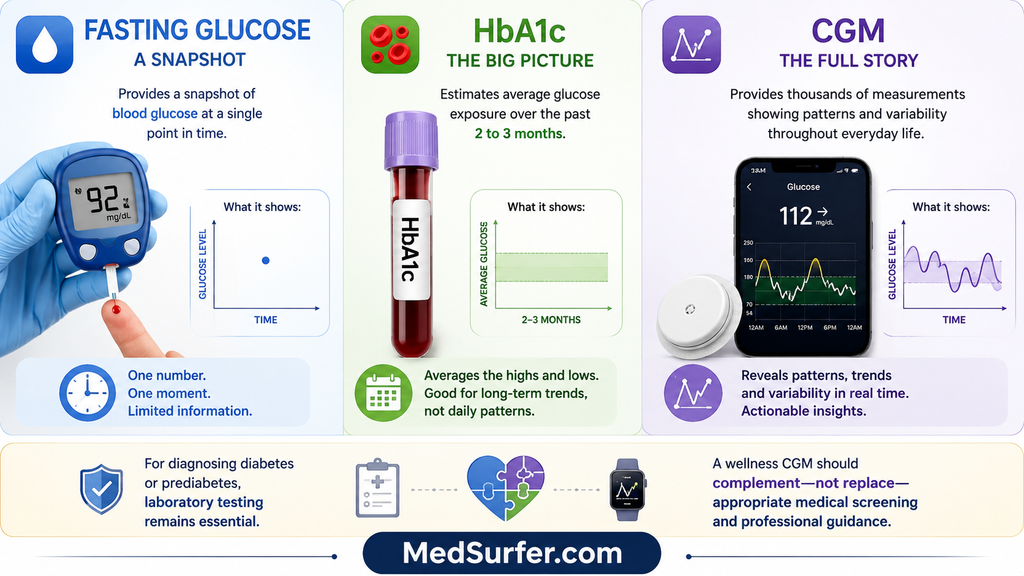
CGM vs. HbA1c vs. Fasting Glucose
These tests answer different questions.
Fasting glucose provides a snapshot of blood glucose at a single point in time.
HbA1c estimates average glucose exposure over the past 2 to 3 months.
CGM provides thousands of measurements showing patterns and variability throughout everyday life.
For diagnosing diabetes or prediabetes, established laboratory testing remains essential.
A wellness CGM should complement—not replace—appropriate medical screening.
Can You Buy a CGM on Amazon?
Availability changes, and CGMs should be purchased only from reputable sellers because sensors require proper handling and storage.
For readers comparing current availability:
Amazon – Dexcom Stelo:
Search Dexcom Stelo on Amazon
Amazon – Continuous Glucose Monitors:
Compare continuous glucose monitors on Amazon
MedSurfer may earn a commission from qualifying purchases made through affiliate links, at no additional cost to you.
For Stelo and Lingo specifically, purchasing directly from the manufacturer may provide clearer eligibility, support, and replacement policies.
Frequently Asked Questions
What is the best CGM for non-diabetics in 2026?
Dexcom Stelo is MedSurfer’s best overall CGM for most non-diabetic adults, particularly those interested in general metabolic-health feedback. Abbott Lingo is an excellent alternative for users who prioritize nutrition tracking and lifestyle coaching.
Can you get a continuous glucose monitor without diabetes?
Yes. FDA-cleared OTC glucose-monitoring systems, including Dexcom Stelo and Abbott Lingo, can be purchased by eligible consumers without a prescription.
Can you buy a CGM without a prescription?
Yes. OTC CGMs have made prescription-free glucose monitoring possible in the United States.
Is CGM useful if I don’t have diabetes?
Possibly. A CGM can show how meals, exercise, sleep and stress relate to your glucose patterns. However, evidence that routine CGM use improves long-term health outcomes in otherwise healthy people remains limited.
What should glucose be in someone without diabetes?
Clinical interpretation should rely primarily on validated diagnostic measurements rather than trying to diagnose yourself from individual CGM readings. Fasting plasma glucose below 100 mg/dL and HbA1c below 5.7% are generally considered within normal diagnostic ranges, while higher results may warrant evaluation for prediabetes or diabetes.
Should I worry about every glucose spike?
No. Glucose levels normally increase after eating, particularly after carbohydrate-rich meals. The size, duration, and context of the response matter more than the mere presence of a rise.
Is Stelo better than Lingo?
Neither is universally better. Stelo is an excellent all-around choice for glucose monitoring and metabolic insights, while Lingo has a particularly strong nutrition and lifestyle experience.
How long should a non-diabetic wear a CGM?
For someone primarily interested in learning about lifestyle responses, two to four weeks may provide substantial information. There is currently little evidence that every healthy adult benefits from indefinite CGM use.
The Bottom Line
Continuous glucose monitoring has entered an entirely new phase.
You no longer need diabetes—or even a prescription—to see how your glucose changes throughout the day.
For most non-diabetic adults interested in trying the technology, Dexcom Stelo is our best overall CGM for 2026, with Abbott Lingo close behind for people who want a more nutrition-focused experience.
But the most important takeaway isn’t which sensor you buy.
It’s about understanding what the information means.
CGMs can be powerful feedback tools. They may reveal how your body responds to different meals, movement, sleep and stress. For people with prediabetes or metabolic risk factors, those insights may be especially valuable.
At the same time, current research does not prove that healthy adults need continuous glucose monitoring or that eliminating every post-meal glucose rise prevents disease.
Think of a CGM as a behavioral feedback tool—not a metabolic report card.
Use the information to reinforce proven habits: eat minimally processed foods, prioritize protein and fiber, exercise regularly, maintain muscle, sleep adequately and stay physically active.
Those behaviors have considerably stronger evidence for long-term health than chasing a perfectly flat glucose curve.
Related Reading on MedSurfer
For a broader look at how nutrition and whole-body physiology interact, read MedSurfer’s What Is the Gut-Brain Axis and Why Does It Matter?: Read the MedSurfer guide
You may also be interested in MedSurfer’s evidence-based Postbiotic Supplements: Benefits, Risks, and What the Research Shows: Read the postbiotics guide
As MedSurfer’s Fitness & Mobility library expands, glucose-monitoring articles should also be internally linked with resistance training, walking, chair exercise and healthy-aging content because skeletal muscle activity is an important component of metabolic health.
References
- U.S. Food and Drug Administration. FDA Clears First Over-the-Counter Continuous Glucose Monitor. March 5, 2024. The FDA clearance specifically notes that Stelo can be used by adults without diabetes who want to understand how diet and exercise affect glucose.
FDA: First OTC Continuous Glucose Monitor - U.S. Food and Drug Administration. Lingo Glucose System, 510(k) K233655. Abbott’s Lingo received FDA clearance as an OTC integrated continuous glucose monitoring system.
FDA Devices Database: Lingo Glucose System - U.S. Food and Drug Administration. Integrated Continuous Glucose Monitor for Non-Intensive Glucose Management, Over-the-Counter. FDA device classification and intended-use information.
FDA CGM Device Classification - Dexcom. Stelo Glucose Biosensor. Current product specifications include up to 15-day wear, continuous glucose tracking and lifestyle-oriented insights.
Stelo Product Information - Dexcom. How the Stelo Glucose Biosensor Works. Current information regarding sensor wear, glucose tracking, app functionality and integrations.
How Stelo Works - Abbott. Lingo CGM Biosensor & App. Current product specifications, sensor duration, app features and purchasing plans.
Abbott Lingo Product Information - Jarvis PRE, Cardin JL, Nisevich-Bede PM, McCarter JP. Continuous glucose monitoring in a healthy population: understanding the post-prandial glycemic response in individuals without diabetes mellitus. Metabolism. 2023;146:155640.
Review: CGM in a Healthy Population - Epic Research. Continuous, Intermittent, and No Glucose Monitoring All Associated with Negligible Changes in Average Blood Glucose Among Nondiabetic Adults After 6 to 18 Months. 2025. The analysis included 9,675 adults without evidence of diabetes and found negligible HbA1c changes regardless of monitoring strategy.
Epic Research CGM Analysis - Washington State Health Care Authority. Continuous Glucose Monitors — New Populations: Final Evidence Report. February 2025. Comprehensive evidence assessment examining CGM use beyond traditional intensive insulin-treated populations.
Continuous Glucose Monitors Evidence Report - Kuwabara M, et al. Assessment of glycemic variability and lifestyle behaviors in nondiabetic individuals. PLOS ONE. Research using continuous glucose monitoring to investigate glucose variability and lifestyle factors among adults without diabetes.
PLOS ONE CGM Study
Medical Disclaimer
This article is for educational and informational purposes only and is not medical advice. Continuous glucose monitor readings should not be used by themselves to diagnose diabetes, prediabetes, hypoglycemia or another medical condition. Consult a qualified healthcare professional regarding abnormal glucose readings, symptoms, medication decisions or concerns about metabolic health.
Product specifications, compatibility, and prices can change. Verify current information with the manufacturer before purchasing.
Some links in this article are affiliate links. MedSurfer may receive a commission from qualifying purchases at no additional cost to the reader. Affiliate relationships do not determine MedSurfer’s editorial conclusions.
About the Author
Adarsh K. Gupta, DO, MS, is a physician, wellness coach, educator, and author with expertise in evidence-based medicine, weight management, healthy habits, and lifestyle change. His work focuses on translating clinical research into practical strategies people can use to improve health and wellness.
Editorial Review Note
MedSurfer health content is developed using peer-reviewed research, regulatory sources, and evidence-based clinical guidance. Product recommendations consider regulatory status, intended use, available research, usability, and practical value. Commercial relationships and affiliate links are kept separate from editorial conclusions.

