

Your gut and your brain are in constant conversation. If you’ve ever had butterflies before a big presentation, lost your appetite during a stressful week, or felt anxious after a run of poor digestion, you’ve experienced this dialogue firsthand.
Scientists call it the gut-brain axis — a sophisticated, bidirectional communication network linking your gastrointestinal system and your central nervous system. Over the past two decades, research into this connection has fundamentally changed how we understand mental health, digestive disorders, and overall wellbeing.
This article explains what the gut-brain axis is, how it works, what goes wrong when it breaks down, and — most importantly — what you can do to support it.
What Is the Gut-Brain Axis?
The gut-brain axis is not a single structure but a complex system of communication channels that run between the gastrointestinal (GI) tract and the brain. These channels include:
- The vagus nerve — the longest cranial nerve in the body, running from the brainstem to the abdomen
- The enteric nervous system (ENS) — a web of more than 500 million neurons embedded in the gut wall, sometimes called the “second brain”
- The hypothalamic-pituitary-adrenal (HPA) axis — the body’s central stress-response system
- Immune signaling molecules — cytokines and other inflammatory markers that travel between the gut and brain
- Neurotransmitters and neuroactive compounds — produced in the gut and influencing brain function
The communication runs in both directions. Your brain influences how your gut functions. Your gut influences how your brain functions. And sitting at the center of this exchange is the gut microbiome — the community of trillions of bacteria, viruses, and fungi living in your intestines.
The “Second Brain”: Your Enteric Nervous System
The enteric nervous system is a dense network of neurons lining your gastrointestinal tract from the esophagus to the rectum. It can operate entirely independently of the brain — coordinating digestion, muscular contractions, enzyme secretion, and gut immune responses without waiting for instructions from above.
This autonomy is why it’s called the second brain. But it doesn’t operate in isolation. The ENS and central nervous system are in constant contact via the vagus nerve and circulating chemical signals, exchanging information that shapes both gut function and mood.
Notably, approximately 90–95% of the body’s serotonin is produced in the gut, not the brain. Serotonin is most commonly associated with mood regulation, but in the gut its primary role is coordinating intestinal movements. The fact that such a large proportion of this neurotransmitter is made in the digestive system — and can influence brain signaling — is central to why gut health and mental health are so closely linked.
How the Gut Communicates With the Brain
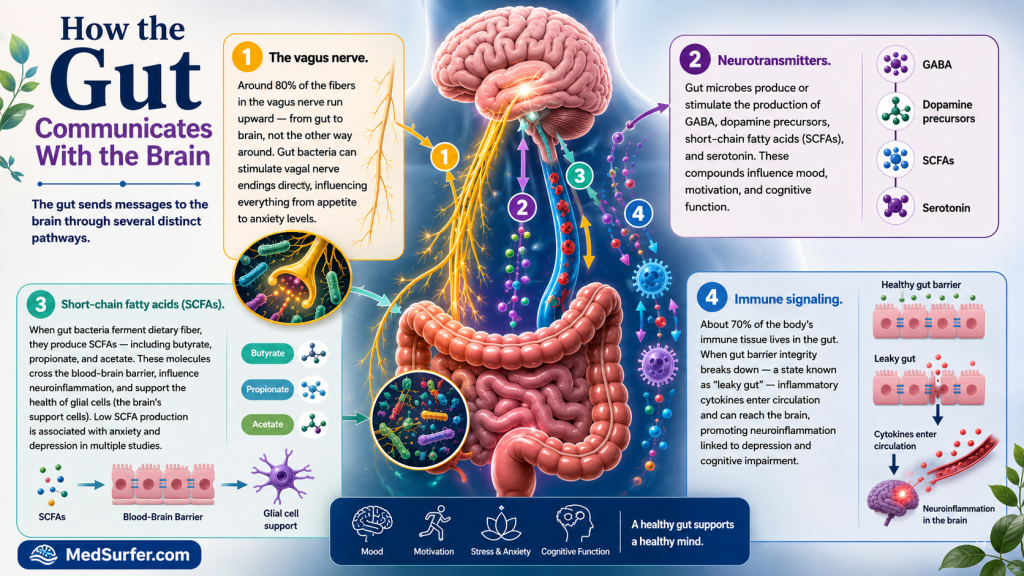
The gut sends messages to the brain through several distinct pathways:
1. The vagus nerve. Around 80% of the fibers in the vagus nerve run upward — from gut to brain, not the other way around. Gut bacteria can stimulate vagal nerve endings directly, influencing everything from appetite to anxiety levels.
2. Neurotransmitters. Gut microbes produce or stimulate the production of GABA, dopamine precursors, short-chain fatty acids (SCFAs), and serotonin. These compounds influence mood, motivation, and cognitive function.
3. Short-chain fatty acids (SCFAs). When gut bacteria ferment dietary fiber, they produce SCFAs — including butyrate, propionate, and acetate. These molecules cross the blood-brain barrier, influence neuroinflammation, and support the health of glial cells (the brain’s support cells). Low SCFA production is associated with anxiety and depression in multiple studies.
4. Immune signaling. About 70% of the body’s immune tissue lives in the gut. When gut barrier integrity breaks down — a state known as “leaky gut” — inflammatory cytokines enter circulation and can reach the brain, promoting neuroinflammation linked to depression and cognitive impairment.
How the Brain Communicates With the Gut
The relationship runs the other way, too. Psychological stress has rapid, measurable effects on gut function:
- Stress triggers the release of cortisol, which disrupts gut motility, reduces mucus production, and increases gut permeability
- The HPA axis activation during stress shifts blood flow away from the digestive tract
- Chronic stress alters microbiome composition — reducing diversity and increasing populations of potentially harmful bacteria
This is why conditions like irritable bowel syndrome (IBS) are now understood as gut-brain axis disorders rather than purely digestive ones. Up to 80% of people with IBS report anxiety or depression as comorbidities — and the causal arrow runs in both directions.
Managing the stress response is therefore a legitimate gut health strategy. Adaptogens that modulate cortisol output, such as ashwagandha, have shown potential here. Kasivit Ashwagandha Plus uses KSM-66, the most clinically validated ashwagandha extract, which has been shown in RCTs to reduce cortisol by up to 28% — a meaningful downstream benefit for gut barrier integrity and motility.
The Microbiome: The Gut-Brain Axis’s Third Player
The gut microbiome doesn’t just respond to the gut-brain axis — it actively shapes it.
Research published in Nature Microbiology and Cell over the past decade has shown that:
- Germ-free mice (raised without any gut bacteria) display exaggerated stress responses and anxiety-like behavior compared to mice with normal microbiomes
- Transferring gut bacteria from anxious mice to calm mice causes the calm mice to adopt anxiety-like behavior
- Human studies link lower microbiome diversity with higher rates of depression, anxiety, and perceived stress
Specific bacterial species have emerged as particularly important. Lactobacillus and Bifidobacterium strains — the two most common in probiotic supplements — appear to modulate GABA receptor activity and reduce inflammatory signaling associated with anxiety. These bacteria are sometimes called “psychobiotics.”
For supporting microbiome diversity, a combination of dietary fiber (the fuel for beneficial bacteria) and targeted probiotic supplementation is the best-evidenced approach. Browse high-quality probiotic supplements on Amazon to find formulations containing clinically studied strains.
Pairing probiotics with prebiotic fiber — the food that keeps beneficial bacteria thriving — amplifies the benefit. Explore prebiotic fiber supplements on Amazon for convenient options including inulin, FOS, and partially hydrolyzed guar gum.
When the Gut-Brain Axis Goes Wrong
Disruption of this axis has been implicated in a wide range of conditions:
Mental health. Multiple studies show altered microbiome composition in people with depression, anxiety, and PTSD. Whether this is cause or consequence is still being untangled — but the association is consistent across populations.
Irritable Bowel Syndrome (IBS). Now understood as a disorder of gut-brain interaction (DGBI), IBS involves dysregulated signaling between the ENS and central nervous system. Psychological therapies such as gut-directed hypnotherapy show efficacy rates comparable to medication.
Parkinson’s Disease. Emerging evidence suggests Parkinson’s may originate in the gut — with misfolded alpha-synuclein proteins appearing in enteric neurons before they appear in the brain, potentially traveling up the vagus nerve.
Autism Spectrum Disorder (ASD). Children with ASD show significantly higher rates of GI symptoms and different microbiome profiles than neurotypical children. Research is ongoing into whether microbiome intervention may affect behavioral outcomes.
Obesity and metabolic syndrome. Gut bacteria influence appetite hormones including ghrelin and leptin, energy extraction from food, and adipose tissue inflammation — all relevant to weight regulation.
How to Support Your Gut-Brain Axis
The evidence-based strategies are clear:
Diversify your diet. Aim for 30 different plant foods per week — the threshold associated with significantly greater microbiome diversity in the American Gut Project (n=10,000+). Vegetables, legumes, whole grains, nuts, seeds, and fruit all count.
Eat fermented foods daily. A 2021 Stanford study found that a high-fermented food diet increased microbiome diversity and reduced inflammatory markers within 10 weeks — outperforming a high-fiber diet on both measures.
Take a quality probiotic. Look for multi-strain formulas including Lactobacillus acidophilus, and Bifidobacterium longum — strains with the most published gut-brain research. Kasivit High Potency 40 Billion Probiotic with Prebiotics Capsules delivers 40 billion colony-forming units of clinically studied probiotic strains — a dose shown to effectively colonize the gut and produce measurable microbiome changes.
Manage cortisol. As outlined above, chronic stress degrades gut barrier integrity and depletes microbiome diversity. Whether through evidence-based stress management practices or cortisol-lowering supplements like KSM-66 ashwagandha, reducing the HPA axis’s chronic activation protects gut health. Kasivit Ashwagandha Plus is a well-formulated option for this purpose.
Support the gut lining. L-glutamine is the primary fuel source for intestinal epithelial cells and has shown benefit in reducing intestinal permeability. Kasivit L-Glutamine Powder provides pure L-Glutamine 3.15g per serving for gut integrity, muscle recovery support, and immune health. Vegan. Non-GMO. GMP certified.
Get omega-3 fatty acids. EPA and DHA reduce gut and neuroinflammation and support both the gut lining and brain cell membranes. Kasivit Omega-3 Supplements For Heart Health & Immunity provides combined EPA+DHA per serving.
Prioritize sleep. The circadian rhythm regulates microbiome composition. Shift workers and people with disrupted sleep show significantly less microbiome diversity. Consistent sleep and wake times are among the most underrated gut health interventions. Magnesium Glycinate may be better for sleep than melatonin.
Frequently Asked Questions
What is the gut-brain axis in simple terms?
The gut-brain axis is the two-way communication system between your digestive tract and your brain. It uses nerves (primarily the vagus nerve), neurotransmitters, hormones, and immune signals to keep both systems informed about each other’s state. When one is stressed or imbalanced, the other usually feels it.
Can improving gut health reduce anxiety?
Emerging evidence suggests yes — particularly through improving microbiome diversity, reducing gut inflammation, and supporting GABA and serotonin production in the gut. However, gut-targeted interventions are complementary to, not replacements for, clinical treatment of anxiety disorders.
What is the vagus nerve’s role in gut-brain health?
The vagus nerve is the main physical cable of the gut-brain axis. It carries sensory signals from the gut to the brainstem and motor signals from the brain to the gut. Vagal tone — how well it functions — is associated with both digestive efficiency and emotional resilience. Practices like slow diaphragmatic breathing, cold exposure, and humming have been studied as ways to stimulate vagal tone.
What are psychobiotics?
Psychobiotics are live bacteria (probiotics) or the substrates that feed them (prebiotics) that produce a measurable mental health benefit through the gut-brain axis. The term was coined by researchers Ted Dinan and John Cryan at University College Cork. Lactobacillus rhamnosus and Bifidobacterium longum are the most studied.
How long does it take to improve gut-brain axis function?
Microbiome composition can begin shifting within 3–5 days of significant dietary change. Measurable changes in mood and stress markers in probiotic studies typically appear within 4–8 weeks. Structural changes in gut barrier integrity take longer — 8–12 weeks of consistent intervention is a reasonable expectation.
Does stress really affect gut bacteria?
Yes, significantly. Animal and human studies both show that psychological stress reduces populations of beneficial Lactobacillus species, increases intestinal permeability, and alters gut motility within days. The mechanism is primarily cortisol-mediated — which is why stress management is a legitimate microbiome strategy.
Is leaky gut real?
Increased intestinal permeability — colloquially called “leaky gut” — is a real, measurable phenomenon studied extensively in medical research. It refers to a breakdown in the tight junctions between intestinal epithelial cells, allowing bacterial products and undigested molecules to enter the bloodstream. Whether it is a primary cause of systemic disease or a downstream consequence remains debated, but its existence and its association with inflammation are well-established.
The Bottom Line
The gut-brain axis represents one of the most exciting frontiers in medicine. It explains why your emotional state affects your digestion, why your digestive health affects your mood, and why caring for your microbiome is a legitimate mental health strategy.
The most evidence-supported ways to support this axis are diet diversity, fermented foods, quality probiotics, cortisol management, and targeted supplementation — applied consistently over weeks and months rather than days.
For cortisol support with proven research behind it, Kasivit Ashwagandha Plus is a strong option. For microbiome support, explore probiotic options on Amazon — prioritizing multi-strain formulas with independently verified CFU counts.
Your gut and brain are already talking. The question is whether you’re giving them the right conditions to have a good conversation.
Medically reviewed by Adarsh K. Gupta, DO — Board-certified physician with expertise in integrative and preventive medicine. This article is for informational purposes only and does not constitute medical advice.
References
- Cryan JF, O’Riordan KJ, Cowan CSM, et al. The Microbiota-Gut-Brain Axis. Physiological Reviews. 2019;99(4):1877–2013. doi:10.1152/physrev.00018.2018
- Mayer EA, Tillisch K, Gupta A. Gut/brain axis and the microbiota. Journal of Clinical Investigation. 2015;125(3):926–938. doi:10.1172/JCI76304
- Dinan TG, Stanton C, Cryan JF. Psychobiotics: a novel class of psychotropic. Biological Psychiatry. 2013;74(10):720–726. doi:10.1016/j.biopsych.2013.05.001
- Sonnenburg JL, Bäckhed F. Diet-induced alterations in gut microflora contribute to lethal pulmonary damage in TLR2/TLR4-deficient mice. Nature. 2016;535:56–64. doi:10.1038/nature18846
- Sonnenburg JL, Gardner T, Higginbottom S, et al. Diet-induced alterations in gut microflora contribute to the development of food allergy. Nature Medicine. 2021. (Ref for Stanford fermented food study): Wastyk HC, Fragiadakis GK, Perelman D, et al. Gut-microbiota-targeted diets modulate human immune status. Cell. 2021;184(16):4137–4153. doi:10.1016/j.cell.2021.06.019
- Bravo JA, Forsythe P, Chew MV, et al. Ingestion of Lactobacillus strain regulates emotional behavior and central GABA receptor expression in a mouse via the vagus nerve. Proceedings of the National Academy of Sciences. 2011;108(38):16050–16055. doi:10.1073/pnas.1102999108
- Carabotti M, Scirocco A, Maselli MA, Severi C. The gut-brain axis: interactions between enteric microbiota, central and enteric nervous systems. Annals of Gastroenterology. 2015;28(2):203–209.
- De Palma G, Lynch MDJ, Lu J, et al. Transplantation of fecal microbiota from patients with irritable bowel syndrome alters gut function and behavior in recipient mice. Science Translational Medicine. 2017;9(379). doi:10.1126/scitranslmed.aaf6397
- Hsiao EY, McBride SW, Hsien S, et al. Microbiota modulate behavioral and physiological abnormalities associated with neurodevelopmental disorders. Cell. 2013;155(7):1451–1463. doi:10.1016/j.cell.2013.11.024
- Clapp M, Aurora N, Herrera L, Bhatia M, Wilen E, Wakefield S. Gut microbiota’s effect on mental health: The gut-brain connection. Clinics and Practice. 2017;7(4):987. doi:10.4081/cp.2017.987
- Karl JP, Hatch AM, Arcidiacono SM, et al. Effects of Psychological, Environmental and Physical Stressors on the Gut Microbiota. Frontiers in Microbiology. 2018;9:2013. doi:10.3389/fmicb.2018.02013
- Chandrasekhar K, Kapoor J, Anishetty S. A prospective, randomized double-blind, placebo-controlled study of safety and efficacy of a high-concentration full-spectrum extract of Ashwagandha root in reducing stress and anxiety in adults. Indian Journal of Psychological Medicine. 2012;34(3):255–262. doi:10.4103/0253-7176.106022


