

If you’ve listened to a fitness podcast, bought a smartwatch, or followed longevity content lately, you’ve probably heard the advice:
Spend more time in Zone 2.
Zone 2 cardio has become one of the most talked-about exercise strategies for improving aerobic fitness, metabolic health, endurance, and possibly longevity. Runners use it to build an aerobic base. Cyclists may spend hours training at relatively easy intensities. Fitness trackers now display colorful heart-rate zones throughout your workout.
But what exactly is Zone 2 cardio?
More importantly, is it really the metabolic “sweet spot” that social media sometimes makes it out to be?
The answer requires some nuance.
Zone 2 heart rate training can be an excellent way to accumulate sustainable aerobic exercise. But recent research challenges the idea that Zone 2 is uniquely superior to other exercise intensities for mitochondrial health or cardiovascular fitness.
Here’s what the science actually tells us—and how to use Zone 2 without making exercise unnecessarily complicated.
Quick Answer: What Is Zone 2 Cardio?
Zone 2 cardio is a relatively easy-to-moderate aerobic exercise performed below your first lactate or ventilatory threshold.
In practical terms, you should be:
- Breathing faster than at rest
- Able to carry on a conversation
- Exercising at a sustainable pace
- Feeling like you could continue for quite a while
- Working harder than an easy stroll but nowhere near an all-out effort
Walking briskly, cycling, using an elliptical, rowing, swimming, or easy jogging can all become Zone 2 exercise depending on your fitness level.
The important point is that Zone 2 describes physiological intensity—not a particular activity.
Why Is Everyone Talking About Zone 2?
Zone 2 isn’t new.
Endurance athletes have used large volumes of lower-intensity aerobic training for decades. What changed is its migration from elite endurance sports into mainstream fitness and longevity culture.
The enthusiasm centers on several ideas.
Zone 2 exercise may help develop:
- Aerobic endurance
- Mitochondrial adaptations
- Fat oxidation capacity
- Cardiovascular fitness
- Exercise efficiency
- Ability to tolerate greater training volume
It also has one huge practical advantage:
It isn’t brutally hard.
You can perform relatively long sessions without the fatigue associated with repeated high-intensity workouts.
That makes Zone 2 attractive for people trying to build a sustainable exercise habit.
But popularity has also led to exaggerated claims—particularly the idea that a single narrow exercise zone is uniquely responsible for mitochondrial health or longevity.
The evidence is more complicated.
What Heart Rate Is Zone 2?
This is where things get confusing.
There is no universally accepted heart-rate percentage that perfectly defines Zone 2 for everyone.
A commonly used five-zone fitness model places Zone 2 somewhere around 60–70% of maximum heart rate.
You may also encounter recommendations using somewhat different ranges.
These formulas are approximations.
Your actual physiological thresholds depend on:
- Age
- Genetics
- Fitness level
- Medications
- Temperature
- Hydration
- Sleep
- Stress
- Caffeine
- Training history
Two 55-year-old adults can therefore have quite different Zone 2 heart rates.
Zone 2 Heart Rate Calculator
One simple starting point is:
Estimated maximum heart rate = 220 − age
Then calculate approximately 60–70% of that number.
For example, for a 50-year-old:
Estimated maximum heart rate:
220 − 50 = 170 beats/minute
Approximate Zone 2:
102–119 beats/minute
This can provide a starting estimate—but don’t mistake it for a laboratory measurement.
Age-predicted maximum heart rate formulas exhibit considerable interindividual variability.
A Better Tool: The Talk Test
You don’t necessarily need laboratory testing—or even a smartwatch—to estimate an appropriate aerobic intensity.
Try talking.
During moderate aerobic activity, you should generally be able to talk but not comfortably sing. The CDC specifically uses this as a practical way to distinguish moderate-intensity exercise.
Research also supports the talk test as a practical way of approximating exercise intensity around ventilatory and lactate thresholds.
For a practical Zone 2-style workout:
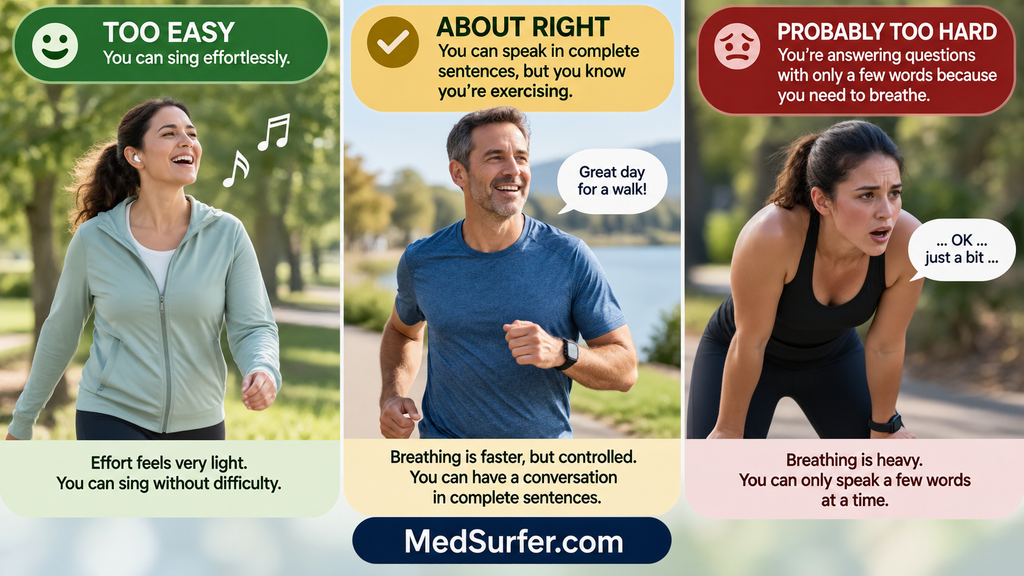
- Too easy: You can sing effortlessly.
- About right: You can speak in complete sentences, but you know you’re exercising.
- Probably too hard: You’re answering questions with only a few words because you need to breathe.
This isn’t laboratory precision.
For most recreational exercisers, it doesn’t need to be.
What Is Happening Inside Your Body During Zone 2 Exercise?
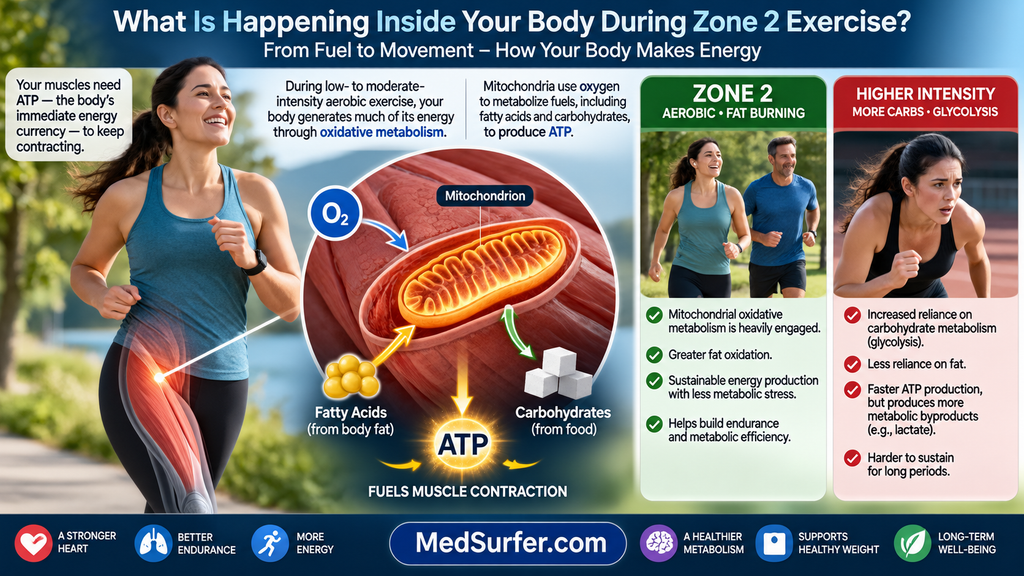
Your muscles need ATP—the body’s immediate energy currency—to keep contracting.
During low- to moderate-intensity aerobic exercise, your body can generate much of that energy through oxidative metabolism.
Mitochondria use oxygen to metabolize fuels including fatty acids and carbohydrates.
As exercise intensity increases, your body increasingly relies on carbohydrate metabolism and glycolytic pathways.
Zone 2 is often described as an intensity where mitochondrial oxidative metabolism and fat oxidation are heavily engaged without producing the metabolic disturbance associated with harder exercise.
This is physiologically interesting.
But it has led to an oversimplification:
“Zone 2 builds mitochondria; harder exercise doesn’t.”
That’s incorrect.
Higher-intensity exercise also stimulates mitochondrial adaptations and can produce substantial improvements in cardiorespiratory fitness.
Does Zone 2 Increase Mitochondria?
Probably—but this needs context.
Regular endurance training produces adaptations that can improve mitochondrial content and function.
However, a major 2025 review in Sports Medicine examined the popular claim that Zone 2 is the optimal intensity for improving mitochondrial capacity and fat oxidation.
The authors concluded that the evidence does not support Zone 2 as uniquely optimal.
They also emphasized substantial evidence supporting higher-intensity exercise for improving mitochondrial capacity and cardiometabolic health, especially when people have limited time to train. citeturn0search0
That’s an important distinction.
Zone 2 is useful.
It isn’t magic.
Zone 2 vs. HIIT: Which Is Better?
This is the wrong question.
They accomplish overlapping but somewhat different training goals.
Zone 2 cardio
Advantages include:
- Lower fatigue
- Easier recovery
- Longer sustainable sessions
- Good aerobic training volume
- Lower perceived difficulty
- Easy integration into everyday life
High-intensity interval training
HIIT can provide:
- Powerful cardiovascular stimulus
- Improvements in VO₂max
- Strong metabolic adaptations
- Time-efficient training
- Higher-intensity performance adaptations
For many people, the best exercise program includes both easier aerobic work and some appropriately prescribed higher-intensity exercise rather than choosing one exclusively.
Zone 2 Cardio vs. Walking
Can walking count as Zone 2?
Absolutely.
For someone beginning exercise, brisk walking may easily raise heart rate into an appropriate moderate-intensity range.
A highly trained endurance athlete, however, may need to walk uphill or jog to achieve the same physiological intensity.
The CDC considers brisk walking a moderate-intensity activity. citeturn0search1turn0search2
This makes walking one of the easiest ways to begin Zone 2-style training.
MedSurfer readers looking for joint-friendly ways to increase activity can also read Low-Impact Mobility: How to Move More Without Picking a Fight With Your Joints. Read the MedSurfer Low-Impact Mobility Guide
Best Zone 2 Cardio Exercises
You don’t need special equipment.
Good choices include:
- Brisk walking
- Incline treadmill walking
- Outdoor cycling
- Stationary cycling
- Elliptical training
- Rowing
- Swimming
- Easy jogging
- Hiking
- Low-impact aerobic exercise
Choose the activity you can perform consistently without significant joint pain.
The “best” Zone 2 exercise is usually the one you’ll actually keep doing.
How Long Should a Zone 2 Workout Be?
For beginners, start with:
20–30 minutes per session, 2–3 times per week.
As fitness improves, sessions can gradually increase to:
30–60 minutes, 3–5 times per week.
You don’t need to immediately start doing 60- or 90-minute workouts.
Current U.S. physical-activity guidance recommends adults accumulate at least 150 minutes of moderate-intensity aerobic activity per week, or 75 minutes of vigorous activity, or an equivalent combination. Adults should also perform muscle-strengthening activity at least two days per week.
That broader recommendation is more important for health than obsessing over whether every aerobic minute was technically Zone 2.
A Simple Zone 2 Workout for Beginners
Try this walking workout.
Warm-up — 5 minutes
Walk comfortably and gradually increase your pace.
Zone 2-style effort — 20–30 minutes
Increase your pace until:
- Breathing becomes noticeably faster
- Heart rate is elevated
- You can still speak in sentences
- Effort feels sustainable
Cool-down — 5 minutes
Gradually slow your pace.
That’s it.
You don’t need a complicated biohacking protocol.
Sample Weekly Exercise Plan
A balanced week could look like:
| Day | Activity |
|---|---|
| Monday | 40-minute Zone 2 walk |
| Tuesday | Full-body strength training |
| Wednesday | 30-minute Zone 2 cycling |
| Thursday | Mobility/recovery |
| Friday | Strength training |
| Saturday | 45–60-minute Zone 2 walk or bike ride |
| Sunday | Rest or easy recreational activity |
More experienced exercisers could add a brief higher-intensity session depending on their goals, conditioning and health status.
The key is balancing aerobic fitness, strength, mobility and recovery.
Is Zone 2 Good for Weight Loss?
Zone 2 exercise burns calories and can contribute to energy expenditure.
Because lower-intensity aerobic exercise uses a greater percentage of fat as fuel than harder exercise, Zone 2 is frequently promoted as the “fat-burning zone.”
This can be misleading.
Burning more fat during a particular workout does not automatically mean losing more body fat over weeks or months.
Body-weight change ultimately depends heavily on overall energy balance.
The CDC notes that physical activity increases energy expenditure, but most weight loss comes from reducing caloric intake; regular activity becomes especially important for maintaining weight loss. citeturn0search7
Zone 2 may nevertheless help because it allows people to accumulate substantial activity without excessive fatigue.
Does Zone 2 Improve Blood Sugar?
Aerobic exercise can improve glucose utilization and insulin sensitivity.
Muscle contractions increase glucose uptake, and regular physical activity plays an important role in metabolic health.
If you’re interested in seeing how physical activity affects your own glucose patterns, MedSurfer’s Best CGM for Non-Diabetics in 2026: Stelo vs. Lingo Compared explains what continuous glucose monitors can—and cannot—tell people without diabetes. Read MedSurfer’s CGM Guide
Importantly, a good glucose response to exercise doesn’t mean you need a CGM to exercise effectively.
Do You Need a Heart Rate Monitor?
No.
The talk test and perceived exertion may be sufficient for most recreational exercisers.
However, a heart-rate monitor can be useful if you enjoy tracking data or want more consistent feedback.
Chest straps generally measure heart rate more directly than wrist-based optical sensors during exercise, while watches are more convenient for everyday use.
For readers comparing equipment:
Amazon heart-rate monitor search
Amazon chest-strap heart-rate monitors
MedSurfer may earn a commission from qualifying purchases at no additional cost to you.
A device can measure heart rate.
It cannot automatically determine your exact physiological Zone 2 unless its zones have been appropriately individualized.
Common Zone 2 Mistakes
1. Treating your smartwatch zones as laboratory measurements
Your watch may estimate zones from age, maximum heart rate or historical data.
Useful? Yes.
Perfect? No.
2. Going too hard
Many people turn an easy aerobic session into a moderate-to-hard workout.
If you can’t comfortably speak, you’ve probably drifted above the intended intensity.
3. Going too easy
A leisurely stroll may not provide much cardiovascular stimulus for a fit individual.
Increase speed or incline if needed.
4. Doing only Zone 2
Zone 2 shouldn’t replace strength training or all vigorous activity.
Adults are advised to combine aerobic exercise with muscle-strengthening exercise at least twice weekly. citeturn0search2
5. Believing Zone 2 is the secret to longevity
Physical activity has extensive health benefits.
But no compelling evidence shows that maintaining one particular heart-rate zone is a unique longevity intervention.
Don’t confuse a useful training strategy with a biological hack.
Who Should Be Careful With Heart Rate Zones?
Heart-rate formulas may be less useful for people taking medications that alter heart rate, particularly beta blockers and some cardiovascular medications.
Medical conditions can also affect appropriate exercise intensity.
Talk with your healthcare professional before significantly increasing exercise if you have:
- Known cardiovascular disease
- Unexplained chest discomfort
- Significant shortness of breath
- Fainting or unexplained dizziness
- Significant arrhythmias
- Poorly controlled hypertension
- Major chronic disease affecting exercise tolerance
- A long period of inactivity combined with plans for vigorous exercise
The CDC similarly advises people with chronic conditions to discuss appropriate types and amounts of activity with a healthcare professional.
Frequently Asked Questions About Zone 2 Cardio
What is Zone 2 cardio?
Zone 2 cardio generally refers to sustained aerobic exercise performed immediately below the first lactate or ventilatory threshold. Practically, it feels relatively comfortable and allows you to speak in sentences while exercising.
What percentage of maximum heart rate is Zone 2?
Many consumer five-zone systems estimate Zone 2 at approximately 60–70% of maximum heart rate, but definitions differ. A fixed percentage may not accurately identify your physiological threshold. You can use this Zone 2 Calculator.
How do I know I’m in Zone 2 without a heart-rate monitor?
Use the talk test. You should be breathing harder but still able to carry on a conversation. If speaking several sentences becomes difficult, your intensity is probably too high.
Is walking Zone 2 cardio?
It can be. Brisk walking may put many people into an appropriate moderate aerobic intensity. Fitter people may need hills, incline treadmill walking, cycling or jogging.
How long should I stay in Zone 2?
Beginners can start with 20–30 minutes and gradually work toward 30–60-minute sessions. Weekly total activity and consistency matter more than hitting a perfect session duration.
Is Zone 2 better than HIIT?
Not universally. Zone 2 allows substantial aerobic volume with relatively low fatigue, while higher-intensity training can provide a powerful and time-efficient cardiovascular stimulus. Many people benefit from combining intensities.
Does Zone 2 burn belly fat?
Zone 2 uses substantial fat oxidation during exercise, but you cannot selectively burn abdominal fat by training in one heart-rate zone. Long-term fat loss depends on overall energy balance, nutrition, physical activity and other factors.
Is Zone 2 the best exercise for mitochondrial health?
Current evidence does not establish that. Zone 2 can promote endurance adaptations, but higher-intensity exercise also improves mitochondrial capacity. A 2025 review specifically challenged claims that Zone 2 is uniquely optimal.
Can I do Zone 2 every day?
Some trained individuals tolerate frequent low-intensity aerobic activity. Beginners should build gradually and consider total exercise volume, strength training, joint symptoms, sleep and recovery rather than assuming more is always better.
The Bottom Line
Zone 2 cardio deserves much of its popularity—but not all of its hype.
It offers something extremely valuable: aerobic exercise that is challenging enough to stimulate adaptation yet comfortable enough to perform regularly and for relatively long periods.
That’s an excellent combination for building an aerobic base.
But the evidence doesn’t support treating Zone 2 as a magical metabolic zone.
You don’t need to maintain a perfect heart rate to improve your mitochondria. You don’t need an expensive wearable to know whether you’re exercising effectively. And you shouldn’t eliminate strength training or higher-intensity exercise simply because Zone 2 is currently popular.
For most people, the practical formula is much simpler:
Move regularly. Accumulate moderate aerobic exercise. Include strength training. Occasionally work harder when appropriate. Recover well. Repeat.
If a heart-rate zone helps you accomplish that consistently, use it.
If it turns exercise into a complicated numbers game, put the watch aside and take a brisk walk.
Your cardiovascular system doesn’t know what color your fitness tracker assigned to the workout.
References
- Storoschuk KL, Moran-MacDonald A, Gibala MJ, Gurd BJ. Much Ado About Zone 2: A Narrative Review Assessing the Efficacy of Zone 2 Training for Improving Mitochondrial Capacity and Cardiorespiratory Fitness in the General Population. Sports Medicine. 2025;55(7):1611–1624.
PubMed: Zone 2 narrative review - Sitko S, et al. What Is “Zone 2 Training”?: Experts’ Viewpoint on Definition, Training Methods, and Expected Adaptations. International Journal of Sports Physiology and Performance. 2025.
PubMed: What Is Zone 2 Training? - Centers for Disease Control and Prevention. How to Measure Physical Activity Intensity. Updated December 2025.
CDC: Measuring Physical Activity Intensity - Centers for Disease Control and Prevention. Adult Activity: An Overview. Recommendations include at least 150 minutes of moderate-intensity activity or 75 minutes of vigorous activity per week plus muscle strengthening.
CDC: Physical Activity Guidelines for Adults - Reed JL, Pipe AL. The Talk Test: A Useful Tool for Prescribing and Monitoring Exercise Intensity. Current Opinion in Cardiology. 2014;29(5):475–480.
PubMed: The Talk Test - Schroeder EC, et al. An Examination and Critique of Subjective Methods to Determine Exercise Intensity: The Talk Test, Feeling Scale, and Rating of Perceived Exertion. Sports Medicine. 2022.
PubMed: Exercise Intensity and Talk Test Review - Centers for Disease Control and Prevention. Physical Activity and Your Weight and Health.
CDC: Physical Activity and Weight - Londeree BR. Effect of Training on Lactate/Ventilatory Thresholds: A Meta-analysis. Medicine & Science in Sports & Exercise. 1997;29(6):837–843.
PubMed: Training and Lactate/Ventilatory Thresholds
Medical Disclaimer
This article is for educational purposes only and is not medical advice. Heart-rate formulas provide estimates and should not be used to diagnose cardiovascular conditions or determine safe exercise intensity for every individual. Consult a qualified healthcare professional before beginning or substantially changing an exercise program if you have cardiovascular disease, significant chronic illness, unexplained symptoms, take medications that affect heart rate, or have concerns about exercise safety.
Some links may be affiliate links. MedSurfer may receive a commission from qualifying purchases at no additional cost to the reader. Affiliate relationships do not determine MedSurfer’s editorial conclusions.
About the Author
Adarsh K. Gupta, DO, MS, is a physician, wellness coach, educator and author with expertise in evidence-based medicine, weight management, healthy habits and lifestyle change. His work focuses on translating clinical research into practical strategies people can use to improve health and wellness.
Editorial Review Note
MedSurfer health content is developed using peer-reviewed research, clinical guidance, and authoritative public health sources. Claims are reviewed for clinical accuracy, practical relevance and consistency with current evidence. Commercial relationships and affiliate links are kept separate from editorial conclusions.


