

This post contains affiliate links. If you purchase through our links, we may earn a commission at no extra cost to you.
How to Fix Your Circadian Rhythm. The short answer is: You fix a circadian rhythm by giving your brain the same signals every day: a consistent wake time, bright light within the first hour after waking, dimmer evenings, and less late caffeine, alcohol, and heavy meals.2,3 Melatonin and sleep formulas are optional add-ons, not the foundation.8,9
If you fall asleep after midnight, wake groggy, feel “tired but wired” at 10 p.m., or crash on weekends, your body clock is likely out of sync with the schedule you want. That clock is your circadian rhythm — a roughly 24-hour timing system that governs sleep, hormones, body temperature, and alertness.1,10
This guide explains what the research actually supports for resetting that clock, what does not work as well as social media claims, and a practical 7-day sequence you can start tomorrow. It is the full protocol. Our shorter piece on morning light covers the single most powerful lever in more detail.
What Is Your Circadian Rhythm?
Your circadian rhythm is an internal timing system generated by a cluster of neurons in the hypothalamus called the suprachiasmatic nucleus (SCN).1,10 The SCN keeps time using gene-protein feedback loops in cells throughout the body. It does not run on willpower. It runs on zeitgebers — environmental cues, especially light.2,11
In humans, the free-running clock is slightly longer than 24 hours for most people. Without daily light, bedtime drifts later. Morning light “phase advances” the clock (makes you sleepy earlier the next night). Evening light “phase delays” it (pushes sleep later).5,6 That is the core finding of decades of human circadian research, including work from Harvard’s Division of Sleep Medicine and the University of Colorado.2,3
Melatonin from the pineal gland rises in dim light as bedtime approaches. Cortisol rises in the early morning to support wakefulness.1 When those curves slide later, common with phones, shift work, and weekend sleep-ins, you get the classic pattern: alert at night, foggy until noon.4,11
Signs Your Circadian Rhythm Is Off
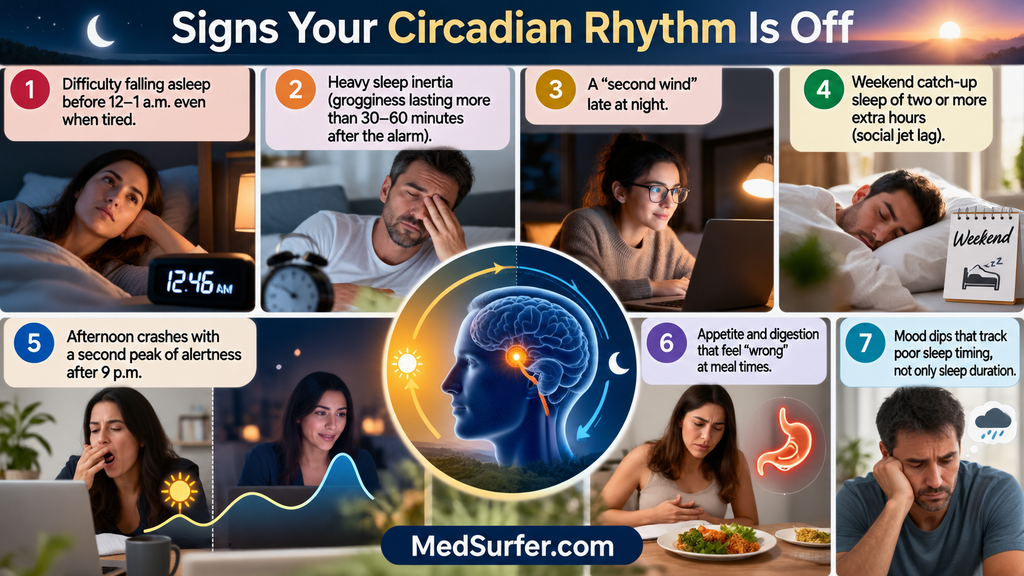
You do not need a lab to notice a delayed or disrupted clock. Common patterns include:
- Difficulty falling asleep before 12–1 a.m. even when tired
- Heavy sleep inertia (grogginess lasting more than 30–60 minutes after the alarm)
- A “second wind” late at night
- Weekend catch-up sleep of two or more extra hours (social jet lag)4
- Afternoon crashes with a second peak of alertness after 9 p.m.
- Appetite and digestion that feel “wrong” at meal times
- Mood dips that track poor sleep timing, not only sleep duration11
These overlap with delayed sleep-wake phase disorder, insomnia, sleep apnea, depression, and iron or thyroid problems.8 Persistent snoring, gasping, severe daytime sleepiness, or mood collapse needs a clinician — not another light gadget.
MedSurfer Verdict: Duration matters, but timing and regularity are circadian problems. A wearable “sleep score” is not a diagnosis.8
How to Fix Your Circadian Rhythm (The Evidence-Based Sequence)
Do these in order. Light and wake time do most of the work.2,9 Everything else is support.
1. Anchor a consistent wake time (including weekends)
This is the non-negotiable. The SCN tracks when you wake more reliably than when you try to fall asleep. Pick a wake time you can keep seven days a week, within about a 30–60 minute window.3
If you currently wake at 11 a.m. on weekends and 6:30 a.m. on weekdays, you are giving your brain weekly jet lag — social jet lag, a term from Roenneberg’s work.4 Shift the weekend wake time toward the weekday time first. Bedtime will follow over several days. Do not force a 10 p.m. bedtime on night one.
A sunrise alarm clock can make an early wake time less brutal by gradually increasing light. It is a cue, not a cure.
2. Get outdoor light in the first hour after waking
Outdoor daylight is orders of magnitude brighter than indoor lamps, even on cloudy days.3,11 Aim for 10–30 minutes outside within an hour of waking. Do not stare at the sun. Face toward daylight; glasses are fine; sunglasses reduce the signal.
If you cannot get outside, sit by the brightest window. A 10,000-lux light box can help in winter or for night-shift recovery, used in the biological morning under clinician guidance — not as all-day décor.8,9 Compare 10,000-lux light therapy boxes on Amazon if you need an indoor option.
This is the same mechanism we describe in morning light for better sleep. Here, it is one step in a full reset, not the whole plan.
3. Dim the evening (especially the last 1–2 hours)
The clock is most sensitive to light in the late evening. Overhead LEDs, TVs, and phones at arm’s length all delay melatonin.5,6,11 You do not need a perfect cave.
Practical version: lower overhead lights after dinner, use a warmer bedside lamp, and keep phones off the pillow. If you must use a screen, reduce brightness and sit farther back. Blue-blocking glasses help some people modestly; they do not cancel a bright living room.
4. Time caffeine, alcohol, and late meals
Caffeine has a half-life of about 5–6 hours in many adults. A 3 p.m. coffee can still be active at 9 p.m. Drake and colleagues showed that caffeine taken even 6 hours before bed still reduced total sleep time.12 Set a personal cutoff 8 hours before target bedtime if you are sensitive.
Alcohol may help you fall asleep and then fragment the second half of the night.9 Heavy meals close to bed can worsen reflux and delay sleep onset. Finish the main meal 2–3 hours before lights out when you can.
5. Move your body earlier, not at midnight
Daytime activity, especially outdoor walking, supports the clock and sleep pressure.3 Intense training within about an hour of bedtime raises core temperature and arousal for some people. Morning or afternoon movement is the circadian-friendly default.
6. Keep the bedroom cool, dark, and boring
Core body temperature falls as sleep approaches.1 A cool room (often around the mid-60s °F / 18–19 °C for many adults) supports that drop. Darkness protects melatonin.2 Reserve the bed for sleep and intimacy so the brain stops pairing it with email.
Blackout curtains and a light-blocking sleep mask are simple ways to protect the dark signal if streetlights or early sunrise leak in.
7. Treat supplements as optional, after the schedule is stable
Melatonin is a timing hormone, not a sedative for most people.89 Low doses taken before desired bedtime are used in circadian protocols for delayed sleep phase and jet lag; high “sleep gummy” doses are more likely to cause next-day grogginess.13 Discuss timing with a clinician if you have a true circadian disorder.
If you want a formulated option after the schedule is in place, Kasivit VitaNight combines melatonin with magnesium, L-theanine, GABA, and herbal extracts (valerian, passionflower). Take it 30–60 minutes before bed only after morning light and wake time are consistent — it cannot replace those cues.
Magnesium may help muscle relaxation and is reasonable if diet is low; it does not reset the SCN.9 VitaNight includes magnesium glycinate in the blend; standalone magnesium glycinate capsules are an alternative if you do not want melatonin.
Ashwagandha has evidence for stress and some sleep quality data, covered in our ashwagandha review — useful for cortisol load, not a light replacement. Do not combine sleep formulas with sedative medicines without a clinician’s go-ahead.
If you want a structured week rather than a list, use our free 7-Day Sleep Reset Plan.
A 7-Day Reset You Can Actually Follow
Days 1–2: Fix wake time. Get morning outdoor light.3 Do not chase an early bedtime yet. Nap only if safety requires it, and keep naps under 20–30 minutes before 2 p.m.
Days 3–4: Dim evenings.11 Move caffeine earlier.12 Add a daytime walk. Bedtime may still be late; that is expected. If racing thoughts still block sleep onset after the lights are down, Kasivit VitaNight can be used as an optional wind-down aid — not as permission to keep a chaotic schedule.
Days 5–7: Protect a wind-down cue (same chair, same dim lamp, same 20 minutes of paper or stretching). If sleep onset is still past your target by more than an hour, shift wake time 15 minutes earlier every few days — not a two-hour jump.9
Shift workers and recent jet lag need a modified plan (light at the new “morning,” dark at the new “night”).8,9 A sleep clinic can time light and melatonin precisely. Guessing with 10 mg melatonin at random hours often makes the delay worse.
What Does Not Fix a Circadian Rhythm
- Sleeping in to “catch up” every Saturday (this re-delays the clock)4
- Using alcohol as a nightcap9
- Chasing a perfect wearable score while ignoring wake time
- All-day sunglasses outdoors in the morning3
- High-dose melatonin at 11 p.m. when your clock is already delayed8
- Expecting one early night to undo months of late light
Cognitive behavioral therapy for insomnia (CBT-I) remains first-line behavioral care for chronic insomnia in American Academy of Sleep Medicine guidance.7 Circadian tools help timing; CBT-I helps the fear and habits around not sleeping. They are complementary.8
How Long Does a Circadian Reset Take?
Most adults feel a difference in 3–7 days of a stable wake time plus morning light.3 A stubborn delayed phase can take 2–3 weeks of consistent cues. The clock shifts on the order of tens of minutes per day under strong, correctly timed light — slower if you keep bright evenings.5,6
If nothing changes after two weeks of honest consistency, look for sleep apnea, restless legs, depression, medications, or a primary circadian disorder.8 That is medical evaluation, not another supplement stack — including VitaNight or Amazon sleep aids.
Frequently Asked Questions
How do you reset your circadian rhythm fast?
The fastest evidence-based reset is a locked wake time plus morning outdoor light and dimmer evenings.2,3 You cannot safely “hack” a six-hour shift overnight. Rapid shifts belong to supervised jet-lag or shift-work protocols.8
Can you fix your circadian rhythm by going to bed earlier?
Usually no — not on night one. The clock must advance first. Wake time and morning light pull bedtime earlier over several days.5 Lying in bed at 9 p.m. while your clock says 1 a.m. often creates insomnia.7
Does morning sunlight really help circadian rhythm?
Yes. Light is the strongest zeitgeber. Outdoor light in the biological morning advances the clock.23 Indoor lighting is typically too weak to replace it. A 10,000-lux box is a backup when you cannot get outside.
Is staying up late a circadian rhythm disorder?
Not by itself. Many people have a later chronotype (“night owls”). It becomes a disorder when the timing is rigid, conflicts with required schedules, and impairs function. Delayed sleep-wake phase disorder is a clinical diagnosis.8
Should I take melatonin or VitaNight to fix my circadian rhythm?
Sometimes, at the right clock time, especially for delayed sleep phase or jet lag.8,13 Kasivit VitaNight is a multi-ingredient formula (melatonin plus magnesium, L-theanine, GABA, and herbs) meant for sleep onset 30–60 minutes before bed. Random high doses at bedtime are a poor substitute for light and schedule.9 Ask a clinician if you are pregnant, on other medicines, or have sleep apnea.
How is circadian rhythm different from sleep hygiene?
Sleep hygiene is a bundle of bedroom and habit tips. Circadian work is specifically about when light, sleep, and meals occur relative to your internal day.1,10 You can have a dark, cool bedroom and still be delayed if you wake at noon and scroll in bed at midnight.
The Bottom Line
To fix your circadian rhythm, stop negotiating with bedtime and start training the clock: same wake time, morning daylight, dimmer nights, earlier caffeine, and patience for a week.2,3,12 That sequence has stronger human evidence than any gadget.
Protect the plan with a simple evening routine — we mapped a realistic one in A Sleep-Supportive Evening Routine. If you still need a non-habit-forming onset aid after the schedule is stable, Kasivit VitaNight or a low-dose melatonin product can sit on top of that plan. If sleep still collapses despite a stable schedule, get evaluated rather than stacking more products.
Medically reviewed by Adarsh K. Gupta, DO, MS — Physician reviewer, MedSurfer. This article is for education, not diagnosis or treatment.
References
- Czeisler CA, Gooley JJ. Sleep and circadian rhythms in humans. Cold Spring Harb Symp Quant Biol. 2007;72:579–597. https://pubmed.ncbi.nlm.nih.gov/18419318/
- Duffy JF, Czeisler CA. Effect of light on human circadian physiology. Sleep Med Clin. 2009;4(2):165–177. https://www.ncbi.nlm.nih.gov/pmc/articles/PMC2742457/
- Wright KP Jr, McHill AW, Birks BR, Griffin BR, Rusterholz T, Chinoy ED. Entrainment of the human circadian clock to the natural light-dark cycle. Curr Biol. 2013;23(16):1554–1558. https://pubmed.ncbi.nlm.nih.gov/23910656/
- Roenneberg T, Allebrandt KV, Merrow M, Vetter C. Social jetlag and obesity. Curr Biol. 2012;22(10):939–943. https://pubmed.ncbi.nlm.nih.gov/22578467/
- Khalsa SBS, Jewett ME, Cajochen C, Czeisler CA. A phase response curve to single bright light pulses in human subjects. J Physiol. 2003;549(Pt 3):945–952. https://pubmed.ncbi.nlm.nih.gov/12717008/
- St Hilaire MA, Gooley JJ, Khalsa SB, Kronauer RE, Czeisler CA, Lockley SW. Human circadian phase-response curve to a 6.5-hour pulse of bright light. J Physiol. 2012;590(13):3035–3045. https://pubmed.ncbi.nlm.nih.gov/22331499/
- Edinger JD, Arnedt JT, Bertisch SM, et al. Behavioral and psychological treatments for chronic insomnia disorder in adults: an American Academy of Sleep Medicine clinical practice guideline. J Clin Sleep Med. 2021;17(2):255–262. https://pubmed.ncbi.nlm.nih.gov/33164742/
- Auger RR, Burgess HJ, Emens JS, Deriy LV, Thomas SM, Sharkey KM. Clinical practice guideline for the treatment of intrinsic circadian rhythm sleep-wake disorders. J Clin Sleep Med. 2015;11(10):1199–1236. https://pmc.ncbi.nlm.nih.gov/articles/PMC4582061/
- Burgess HJ, Emens JS. Circadian-based therapies for circadian rhythm sleep-wake disorders. Curr Sleep Med Rep. 2016;2(3):158–165. https://pubmed.ncbi.nlm.nih.gov/27990327/
- National Institute of General Medical Sciences. Circadian rhythms fact sheet. https://www.nigms.nih.gov/education/fact-sheets/Pages/circadian-rhythms.aspx
- Blume C, Garbazza C, Spitschan M. Effects of light on human circadian rhythms, sleep and mood. Somnologie. 2019;23(3):147–156. https://pubmed.ncbi.nlm.nih.gov/31534436/
- Drake C, Roehrs T, Shambroom J, Roth T. Caffeine effects on sleep taken 0, 3, or 6 hours before going to bed. J Clin Sleep Med. 2013;9(11):1195–1200. https://pubmed.ncbi.nlm.nih.gov/24235903/
- Ferracioli-Oda E, Qawasmi A, Bloch MH. Meta-analysis: melatonin for the treatment of primary sleep disorders. PLoS One. 2013;8(5):e63773. https://pubmed.ncbi.nlm.nih.gov/23696817/


